

For generations, African people preserved history through the spoken word. Stories, experiences, wisdom, warnings, and traditions were passed from one generation to another so that those who came after would know where they came from, understand what their ancestors endured, contributed and carry forward what they had learned.
This history page continues that tradition in a different form.
To understand Pan-Africanism, we must understand both what African people were building and what they were responding to.
Across centuries, people of African descent experienced enslavement, colonial occupation, racial discrimination, economic exploitation, and systems designed to separate people from their land, culture, history, and one another. Ideas of racial superiority were reinforced not only through political power, but also through religious arguments and pseudoscientific theories that attempted to portray Black people as naturally inferior.
The colonization of Africa brought another profound transformation. During the Scramble for Africa, European powers divided much of the continent among themselves. The Berlin Conference of 1884–1885 became an important moment in that process, establishing rules among European powers for claiming African territory. Borders were eventually imposed across communities, kingdoms, ethnic groups, and existing political systems—where we are still seeing consequences around the continent today.
Yet this history is not only a history of what was done to African people.
It is also the history of what African people did in response.
Pan-Africanism developed into an international movement built around a powerful idea: that African people and people of African diaspora throughout the world share histories, struggles, cultural connections, and possibilities for a common future. Its advocates did not all agree on exactly what Pan-Africanism should become. Some emphasized African political unity. Others fought colonial rule, racial oppression, or economic exploitation. Some focused on cultural identity and racial pride, while others organized African and diasporic communities across national borders. But several aspirations repeatedly emerged: ● End colonial rule and foreign domination in Africa. ● Build political, social, and economic strength through cooperation. ● Restore African identity, dignity, self-determination, and pride. ● Strengthen connections among African people throughout the continent and the global African diaspora. Pan-Africanism therefore became more than a political idea. It became a way of imagining what might be possible when people separated by geography, colonial borders, and historical circumstances recognized their connections to one another.
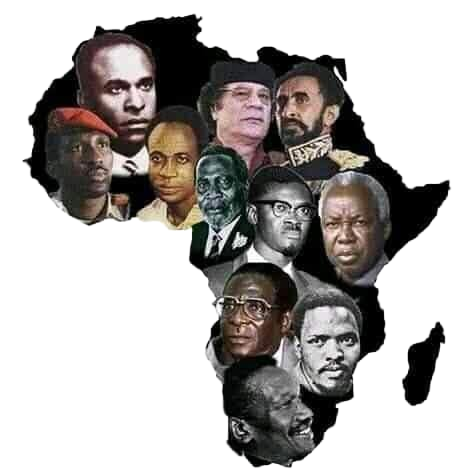
The history of Pan-Africanism is frequently told through its most recognizable male leaders.
Their contributions are important, but they represent only part of the story.
Women were organizers, writers, educators, political leaders, independence activists, diplomats, intellectuals, and institution builders throughout African liberation and Pan-African movements.
They are only a few among many.
Their presence on this page is intentional. Historical memory becomes incomplete when the people who organized, sacrificed, wrote, taught, challenged institutions, and stood on the front lines of change are remembered only partially.
We study this history not simply to return to the past, but to better understand the present.
Pan-African gatherings across Africa and throughout the diaspora continue a much older conversation: Who are we as a people? What has divided us? What connects us? What have we inherited? And what can we build together?
The goal is not to romanticize history. Africa’s past, like the history of every people, contains achievement and conflict, cooperation and division, triumph and tragedy. Understanding all of it allows us to recognize both what changed and what did not.
It also reminds us that Africans were never simply subjects of history.
They were innovators, builders, scholars, organizers, leaders, creators, resisters, and collaborators. Long before today’s national borders existed, African societies traded, governed, created, exchanged knowledge, and interacted across regions. The Pan-African movement drew upon that history while imagining new forms of solidarity for a changing world.
That work continues.
As Nelson Mandela observed:
There is nothing like returning to a place that remains unchanged to find the ways in which you yourself have altered.
And Martin Luther King Jr. reminded us:
“We are not makers of history. We are made by history.“
This page is an invitation to encounter that history—to understand the forces that shaped Pan-Africanism, discover the people who carried it forward, and consider what their struggles, accomplishments, disagreements, and hopes can teach us today.
Angela Davis challenges us:
To not submit to the status-quo oppression, stating: “I am no longer accepting the things I cannot change. I am changing the things I cannot accept.
To know where we are going, we must understand where we have been. And to understand who we can become, we must remember who we have been.
A Chronological Record, 1900 – 2026
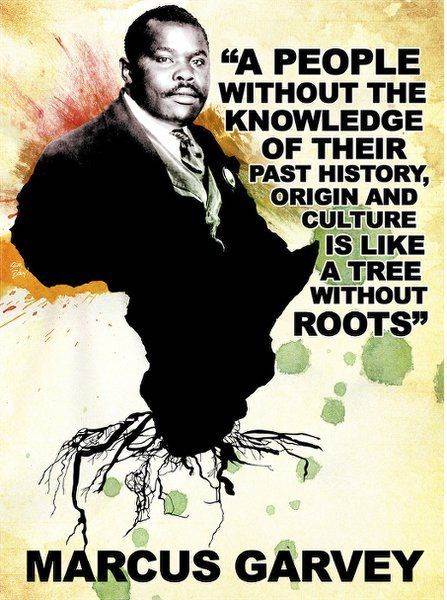
A people without the knowledge of their past history, origin and culture is like a tree without roots.
It might be a good idea if the various countries of the world occasionally swapped history books, just to see what the other people are doing with the same set of facts.”

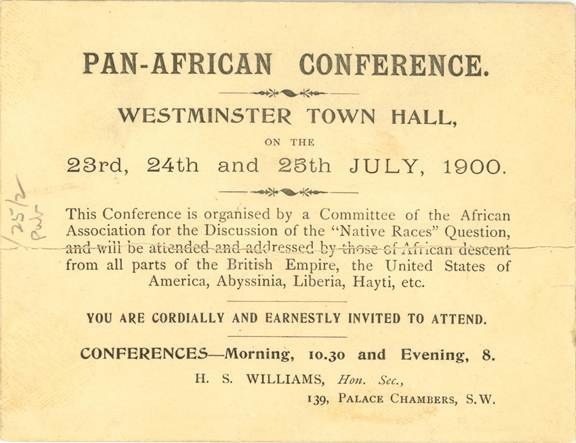
The Pan-African Congress (PAC) is a regular series of meetings that originally took place on the back of the Pan-African Conference held in London, England, in 1900.
The Pan-African Congress first gained a reputation as a peacemaker for decolonization in Africa and in the West Indies, and made a significant advance for the Pan-African cause.
Among the group's primary demands from the outset was the cessation of colonial rule and racial discrimination. The Congress opposed imperialism and called for human rights and economic equality. The manifesto issued by the PAC outlined its political and economic demands for a new global context of international cooperation, emphasizing the necessity to tackle the challenges Africa faced due to widespread European colonization.
The First Pan-African Conference was held in London in 1900. The conference brought together people who were against racism and colonialism and attracted international attention, though it did not lead to political action on these issues. Attendees discussed the need to preserve Black cultural identity and for the rights of indigenous people to be recognized by colonizers.
Du Bois described the fighting done by Black Americans as a "debt of blood" and argued that they deserved reparations for slavery and racial violence. He also believed that ensuring a positive future for Africa would be key to helping all Black people around the world.
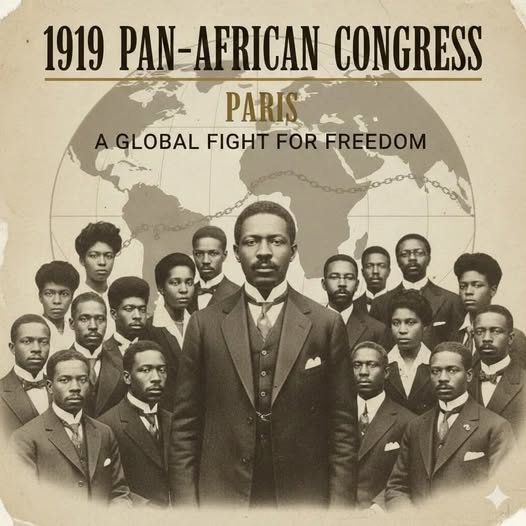
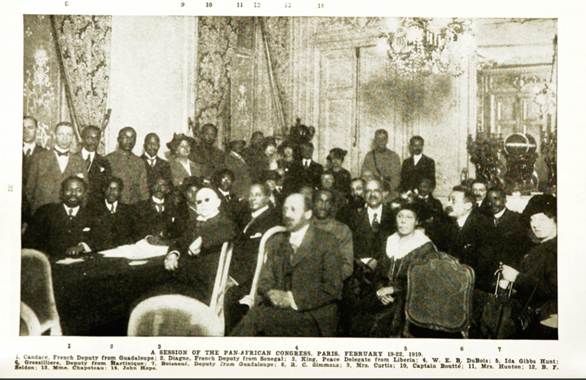
On 19 February 1919, the first Pan-African Congress was organized quickly in Paris by W. E. B. Du Bois, Ida Gibbs Hunt, Edmund Fredericks and Blaise Diagne.
The Pan-African Congress proposed that Germany should be required to turn over its colonies to an international organization rather than other colonial powers.
There were 57 delegates representing 15 countries, a smaller number than originally intended because British and American governments refused to issue passports to citizens who had planned on attending.
It was reported by the U.S. State Department that the French government did not believe the timing was right for a Pan-African Congress. A New York Call writer believed that the U.S. was worried it would be embarrassed by discussions of race relations at the Congress in Paris.
Eventually, the Congress took place between February 19 and 21 at the Grand Hotel. There was greater representation from African countries at the First Pan-African Congress than there had been at the 1900 Pan-African Conference. Africa had twelve delegates, with three from Liberia. There were 21 delegates representing Caribbean countries and 16 delegates from the U.S.
Countries and territories represented in the source document include Senegal, Haiti, Congo, Portugal, Liberia, South Africa, France, Belgium and the USA.
Debate, Representation and Resolutions
The Congress also placed significant value on Black people who had been "civilized" by colonizing powers. For Diagne, Germany should give up its colonies not because colonialism was bad, but because German governance was not good. After Diagne's speech, Portuguese representative Alfredo Andrade praised French democracy and its inclusion of Black people in government.
Other representatives also praised France for having Black representation in politics and good relations with Black people anecdotally. Andrade, Diagne, Gratien Candace, Achille René-Boisneuf, and Joseph Lagrosillière all felt that there was "no room for a diasporan political consciousness because they saw the French Third Republic's empire as the best current opportunity for the realization of black rights within their constituencies." Adherence to a "benevolent" nation was seen as a practical approach to helping improve the lives of Black people they represented.
Helen Noble Curtis gave a speech called "The Use of African Troops in Europe," describing racist experiences Black soldiers fighting in World War I encountered in hospitals and other institutions. Curtis pleaded for the world to recognize that justice is not separate: it should be the same for all people regardless of skin color.
The Congress eventually adopted several resolutions, especially related to people living under colonialism. They advocated for self-determination of African people except where "existing practices were directly contradictory to best established principles of civilization." It was felt that Africa should be granted home rule and Africans should take part in governing their countries as fast as their development permits until at some specified time in the future.
The Congress also placed significant value on Black people who had been “civilized” by colonizing powers. For Diagne, Germany should give up its colonies not because colonialism was bad, but because German governance was not good. After Diagne’s speech, Portuguese representative Alfredo Andrade praised French democracy and its inclusion of Black people in government.
Other representatives also praised France for having Black representation in politics and good relations with Black people anecdotally. Andrade, Diagne, Gratien Candace, Achille René-Boisneuf, and Joseph Lagrosillière all felt that there was “no room for a diasporan political consciousness because they saw the French Third Republic’s empire as the best current opportunity for the realization of black rights within their constituencies.” Adherence to a “benevolent” nation was seen as a practical approach to helping improve the lives of Black people they represented.
Helen Noble Curtis gave a speech called “The Use of African Troops in Europe,” describing racist experiences Black soldiers fighting in World War I encountered in hospitals and other institutions. Curtis pleaded for the world to recognize that justice is not separate: it should be the same for all people regardless of skin color.
The Congress eventually adopted several resolutions, especially related to people living under colonialism. They advocated for self-determination of African people except where “existing practices were directly contradictory to best established principles of civilization.” It was felt that Africa should be granted home rule and Africans should take part in governing their countries as fast as their development permits until at some specified time in the future.
In 1921, the Second Pan-African Congress met in several sessions in London, Brussels and Paris, during August 28, 29 and 31 and September 2, 3, 5 and 6.
As W. E. B. Du Bois reported in The Crisis in November that year, represented at this congress were "26 different groups of people of Negro descent": British Nigeria, Gold Coast and Sierra Leone; the Egyptian Sudan; British East Africa; former German East Africa; French Senegal, the French Congo and Madagascar; Belgian Congo; Portuguese St. Thomé, Angola and Mozambique; Liberia; Abyssinia; Haiti; British Jamaica and Grenada; French Martinique and Guadeloupe; British Guiana; the United States of America; Negroes resident in England, France, Belgium and Portugal; and fraternal visitors from India, Morocco, the Philippines and Annam
An Indian revolutionary, Shapurji Saklatvala, took part, as did W. F. Hutchinson, a journalist from the Gold Coast.
This session of the Congress was the most focused for change of all the meetings thus far. At the London session, resolutions were adopted and later restated by Du Bois in his “Manifesto To the League of Nations.
If we are coming to recognize that the great modern problem is to correct maladjustment in the distribution of wealth, it must be remembered that the basic maladjustment is in the outrageously unjust distribution of world income between the dominant and suppressed peoples; in the rape of land and raw material, and the monopoly of technique and culture. And in this crime white labor is particeps criminis with white capital. Unconsciously and consciously, carelessly and deliberately, the vast power of the white labor vote in modern democracies has been cajoled and flattered into imperialistic schemes to enslave and debauch black, brown and yellow labor.
W. E. B. Du Bois, “Manifesto To the League of Nations
This led to fears among businesses and the government in Brussels that the Congress would be a radical event advocating the overthrow of colonial rule. Panda Farnana even tried suing the newspaper L'Avenir Colonial Belge for having smeared and discredited the Pan-African Congress.
The smear campaign made many in Brussels see the meeting as a "gathering of dangerous agitators who, like their leader Marcus Garvey, were bent on freeing Africa from European rule." However, Garvey saw the Congress as little more than a joke and sharply criticized it and Du Bois loudly and publicly.
In 1923, the Third Pan-African Congress was held in London and Lisbon. Helen Noble Curtis was an important planner of the Lisbon event, which was smaller than the others. The London Congress was held at Denison House.
This meeting repeated demands for self-rule and addressed problems in the Diaspora and the African-European relationship.
· The development of Africa should be for the benefit of Africans and not merely for the profits of Europeans.
· There should be home rule and a responsible government for British West Africa and the British West Indies.
· The pretension of a white minority to dominate a Black majority in Kenya, Rhodesia and South Africa should be abolished.
· Lynching and mob law in the United States should be suppressed.
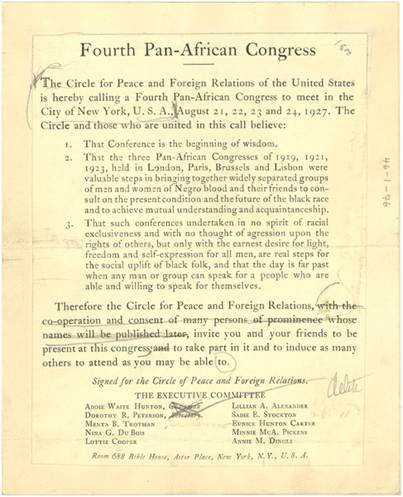
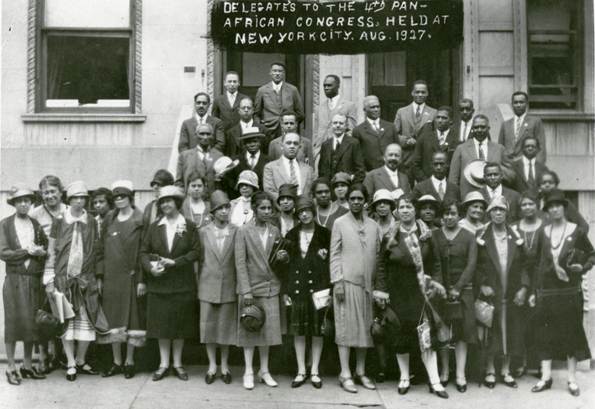
Women played a significant role in this congress. Addie Whiteman Dickerson, Addie Hunton and the Women’s International League for Peace and Freedom were key fundraisers for the meeting. The Circle for Peace and Foreign Relations of New York City was also one of the sponsors.
Beatrice Morrow Cannady, Dora Cole Norman, Dorothy R. Peterson and Jessie Redmon were active in planning for the Fourth Congress. The Grace Congregational Church served as planning headquarters.
There were about 208 delegates from the United States and other countries. Low attendance from British and French colonies was due to government travel restrictions.
The Fourth Pan-African Congress adopted resolutions similar to the Third Pan-African Congress meetings. Resolutions called for the liberation of various colonized countries, including Haiti, China and Egypt. A call for working-class solidarity across racial lines was also included, but no plans for how to accomplish this were made.
There were 208 delegates from the United States and 10 different foreign countries. Africa was represented by delegates from the Gold Coast, Liberia, Nigeria and Sierra Leone.
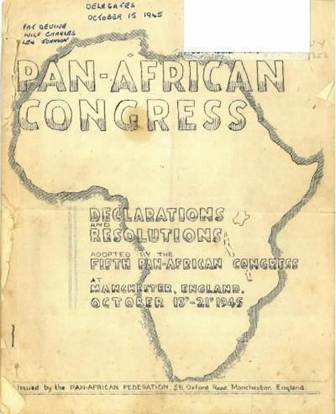
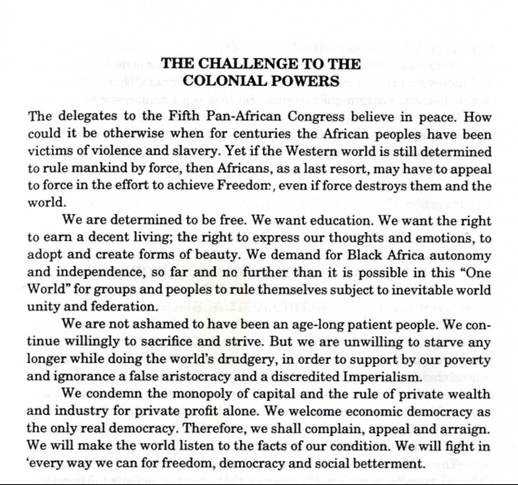
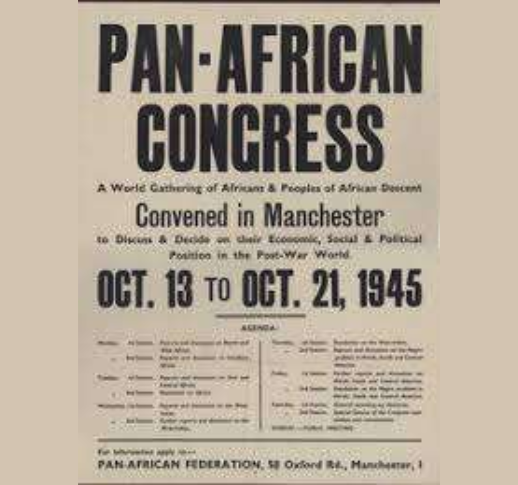
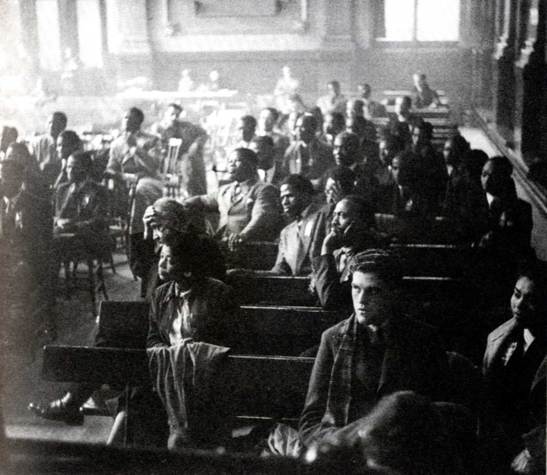
The foundation of the Pan-African Federation (PAF) in Manchester in 1945, the Fifth Pan-African Congress was held at the Chorlton-on-Medlock Town Hall, Manchester, United Kingdom, between 15 and 21 October 1945.
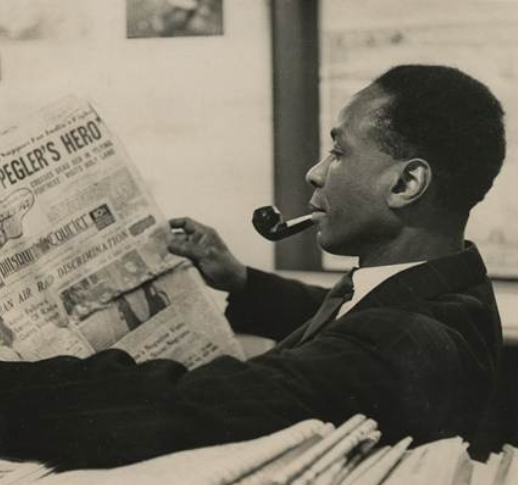
Although forming part of a larger Pan-African movement at the beginning of the century, this event was organized by people in Manchester, who brought in people from all over the world.
At the end of World War II, around 700 million people lived under imperial rule and were “subject people,” with no freedoms, no parliaments, no democracy and no trade unions to protect workers. Many felt betrayed after being promised movement towards self-government if they fought for European colonial powers during the First World War, only to have such promises later denied. A new militancy had emerged with demands for decolonization as well as condemnation of imperialism, racial discrimination and capitalism.
Historian Saheed Adejumobi writes in The Pan-African Congresses, 1900-1945 that “while previous Pan-African congresses had been controlled largely by black middle-class British and American intellectuals who had emphasized the amelioration of colonial conditions, the Manchester meeting was dominated by delegates from Africa and Africans working or studying in Britain.”
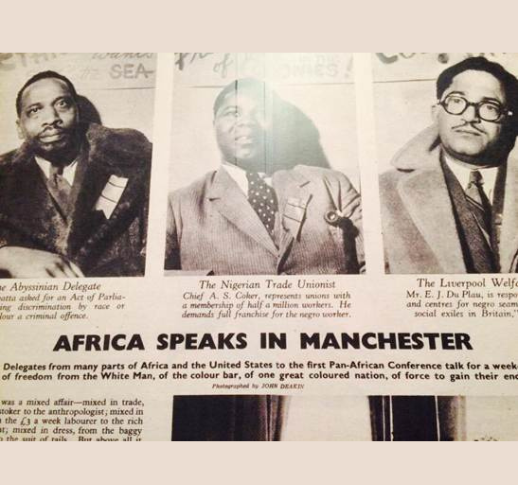
Adejumobi notes that “the new leadership attracted the support of workers, trade unionists, and a growing radical sector of the African student population.” With fewer African American participants, delegates consisted mainly of an emerging crop of African intellectual and political leaders who soon won fame, notoriety and power in their various colonized countries.
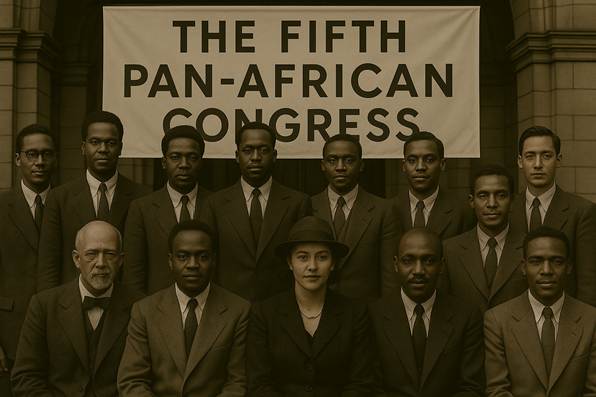
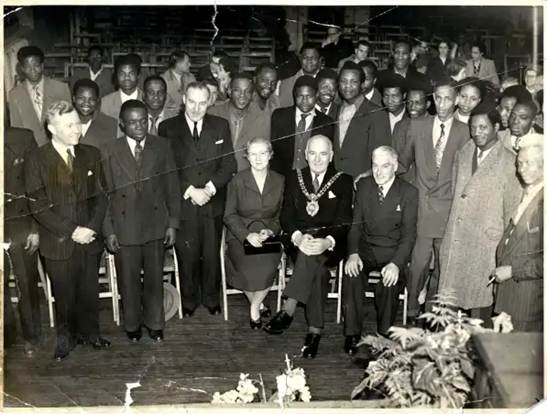
Among attendees were Hastings Banda, Kwame Nkrumah and Jomo Kenyatta, who would go on to be the first presidents of their newly independent countries. Commentators estimate that 87-90 delegates were in attendance, representing some 50 organizations, with a total of 200 audience members present.

· “The Colour Problem in Britain,” including unemployment among Black youth; abandoned mixed-race children fathered by Black ex-servicemen and white British mothers; racial discrimination, the colour bar and discriminatory employment practices. These topics were discussed at the first session on October 15, 1945, chaired by Amy Ashwood Garvey.
· “Imperialism in North and West Africa.” All present demanded independence for African nations; delegates were split on whether political emancipation or control of the economy should come first. Kwame Nkrumah advocated revolutionary methods of seizing power as essential to independence. From this session onwards, the chair was taken by Dr. W. E. B. Du Bois.
· “Oppression in South Africa,” including the social, economic, educational, health and employment inequalities faced by Black South Africans. Those present expressed support and sympathy and outlined a number of demands.
· “The East African Picture,” focusing on land, the occupation of much of the best land by white settlers, and unequal working conditions and wages for Africans. This session was opened by Jomo Kenyatta.
· “Ethiopia and The Black Republics,” discussing Britain exercising control over Ethiopia although Emperor Haile Selassie had been restored to the throne, and the United Nations not offering help to Ethiopia while Italy, which conquered Ethiopia in 1935 under a fascist regime, was receiving UN help.
· “The Problems in the Caribbean.” A number of trade union delegates from the Caribbean addressed the session; some demanded “complete independence,” some “self-government,” and others “dominion status.”
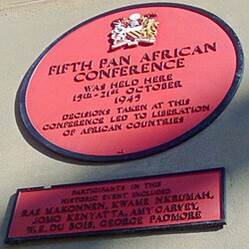
Red Commemorative plaque: It is suggested by commentators that Manchester community leader and political activist Kath Locke persuaded Manchester City Council to place a red plaque commemorating the Congress on the wall of Chorlton Town Hall.

The Organization of African Unity (OAU) was established on May 25, 1963, in Addis Ababa, Ethiopia, by 32 newly independent African states determined to assert their sovereignty. Its founding marked a historic turning point, as African leaders sought to overcome the legacy of colonialism through unity and solidarity.
At its core, the OAU aimed to accelerate the liberation of the remaining colonized territories, defend the independence of member states, and promote political coordination across the continent.
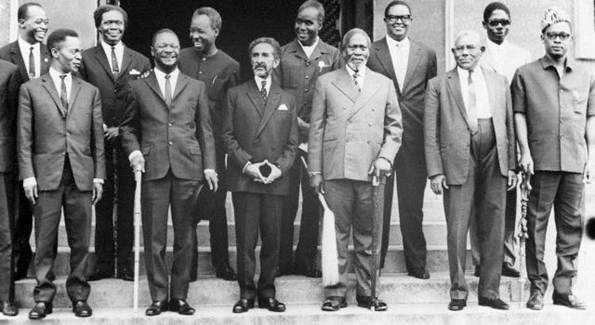
The organization was shaped by visionary leaders such as Ethiopia’s Emperor Haile Selassie, Ghana’s Kwame Nkrumah, Nigeria’s Abubakar Tafawa Balewa, Guinea’s Ahmed Sékou Touré and others.
The source document identifies prominent leaders pictured as Emperor Haile Selassie of Ethiopia, Jomo Kenyatta of Kenya, Julius Nyerere of Tanzania, Milton Obote of Uganda and Kenneth Kaunda of Zambia. It also describes an iconic group photo of founding fathers and early leaders at the establishment of the OAU in Addis Ababa in 1963, including Haile Selassie, Kwame Nkrumah, Gamal Abdel Nasser, Julius Nyerere and others who shaped post-colonial Africa.
The Compromise Resolutions
· Emperor Haile Selassie hosted the summit to bridge competing positions, ultimately adopting a charter closer to the gradualist Monrovia approach:
· Sovereignty: Absolute respect for the sovereignty and territorial integrity of each member state.
· Inviolability of Borders: Commitment to maintaining the colonial-era borders to prevent cross-border conflicts.
· Decolonization: Creation of a Liberation Committee to actively fund and support anti-colonial movements in remaining European-ruled territories, such as Angola, Mozambique and apartheid South Africa.
The Sixth Pan-African Congress, also known as “Sixth-PAC” or “6PAC,” was hosted in Dar es Salaam, Tanzania, in June 1974. This was the first time the event took place in Africa. The event was originally proposed by Pauulu Kamarakafego to challenge neocolonialism and apartheid.
Hundreds to thousands of participants met at the University of Dar es Salaam from June 19 to June 27, 1974. Around 50 different sovereign governments and political organizations sent delegates to 6PAC. Delegates from liberation movements from several colonized countries also attended.
Hill served as the secretary general for North America. It was part of the original planning that groups working towards liberation have time to network and “build international solidarity.”
A General Political Statement was created at 6PAC calling for an end to all forms of colonialism, including neocolonialism. The statement also called for a unification of African people to work towards socialism throughout Africa to end oppression. It explicitly called out all kinds of racism and nationalism.
Augusto stayed in Dar es Salaam after 6PAC to edit the proceedings of the event for the Tanzania Publishing House.
Several North American activists from 6PAC went on to Washington, D.C., in the fall of 1974 to lobby the United States to take action against apartheid in South Africa. Under Hill's leadership, this grew into the Southern Africa News Collective and eventually, in 1978, became the Southern Africa Support Project (SASP).
The Organisation of African Unity (OAU) was established in 1963 with the primary aim of eradicating colonialism and improving political cooperation among African states. It was a political body that focused on the sovereignty and independence of African states, promoting unity and solidarity among African nations. The OAU was successful in its anti-colonial and anti-apartheid advocacy, leading to the independence of many African countries. However, it was often criticised for its principle of
non interference, which allowed member states to commit human rights abuses without intervention from the organisation.
On the other hand, the African Union (AU), established in 2002, has a broader mandate that includes not only political but also economic integration among its member states. It aims to promote sustainable development at the economic, social and cultural levels as well as to integrate African economies. The AU has the power to intervene in member states in grave circumstances such as war crimes, genocide and crimes against humanity, a significant shift from the OAU’s principle of non-interference. The AU also has a peace and security council, which is responsible for maintaining continental peace and security, something the OAU did not have. This council has the power to implement peacekeeping missions and impose sanctions, demonstrating the AU’s commitment to conflict prevention and resolution.
Furthermore, the AU has a Pan-African Parliament, a body that aims to provide a common platform for African peoples and their grassroots organisations to be more
involved in discussions and decision-making on the problems and challenges facing Africa. This is a clear move towards more inclusive and participatory governance.

The Sixth Pan-African Congress, also known as “Sixth-PAC” or “6PAC,” was hosted in Dar es Salaam, Tanzania, in June 1974. This was the first time the event took place in Africa. The event was originally proposed by Pauulu Kamarakafego to challenge neocolonialism and apartheid.
Hundreds to thousands of participants met at the University of Dar es Salaam from June 19 to June 27, 1974. Around 50 different sovereign governments and political organizations sent delegates to 6PAC. Delegates from liberation movements from several colonized countries also attended.
Hill served as the secretary general for North America. It was part of the original planning that groups working towards liberation have time to network and “build international solidarity.”
A General Political Statement was created at 6PAC calling for an end to all forms of colonialism, including neocolonialism. The statement also called for a unification of African people to work towards socialism throughout Africa to end oppression. It explicitly called out all kinds of racism and nationalism.
Augusto stayed in Dar es Salaam after 6PAC to edit the proceedings of the event for the Tanzania Publishing House.
Several North American activists from 6PAC went on to Washington, D.C., in the fall of 1974 to lobby the United States to take action against apartheid in South Africa. Under Hill's leadership, this grew into the Southern Africa News Collective and eventually, in 1978, became the Southern Africa Support Project (SASP).

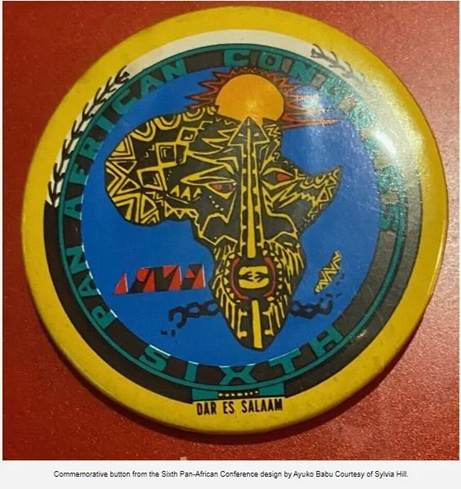
Commemorative button shown with the Seventh Pan-African Congress material.
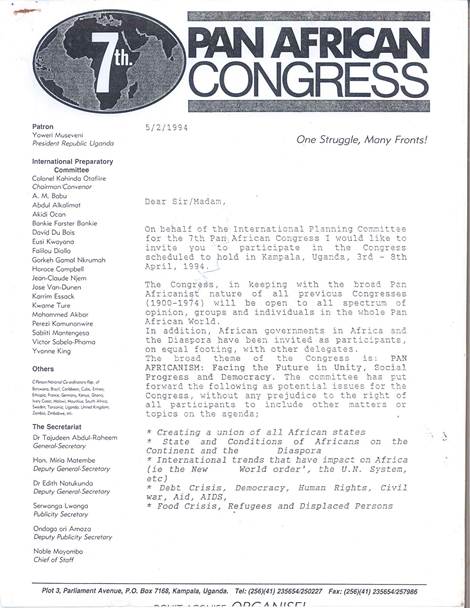
The Seventh Pan-African Congress was held in Kampala, Uganda, from April 3 to April 8, 1994. The theme was “Facing the Future in Unity, Social Progress and Democracy.”
There were more than 2,000 participants at the event, which included a Women's Pre-Congress meeting. Ugandan president Yoweri Museveni spoke at the opening, where he listed five criteria for defining who is an “African.” The criteria, which included people of many backgrounds and nationalities, helped define “African” as something that was not just a racial category.
In addition, 7PAC brought together activists from different generations to work on modern problems together.
Modern issues included HIV/AIDS in Africa, women's rights and globalization. Other tensions to unravel in 7PAC and going forward included Black nationalism.
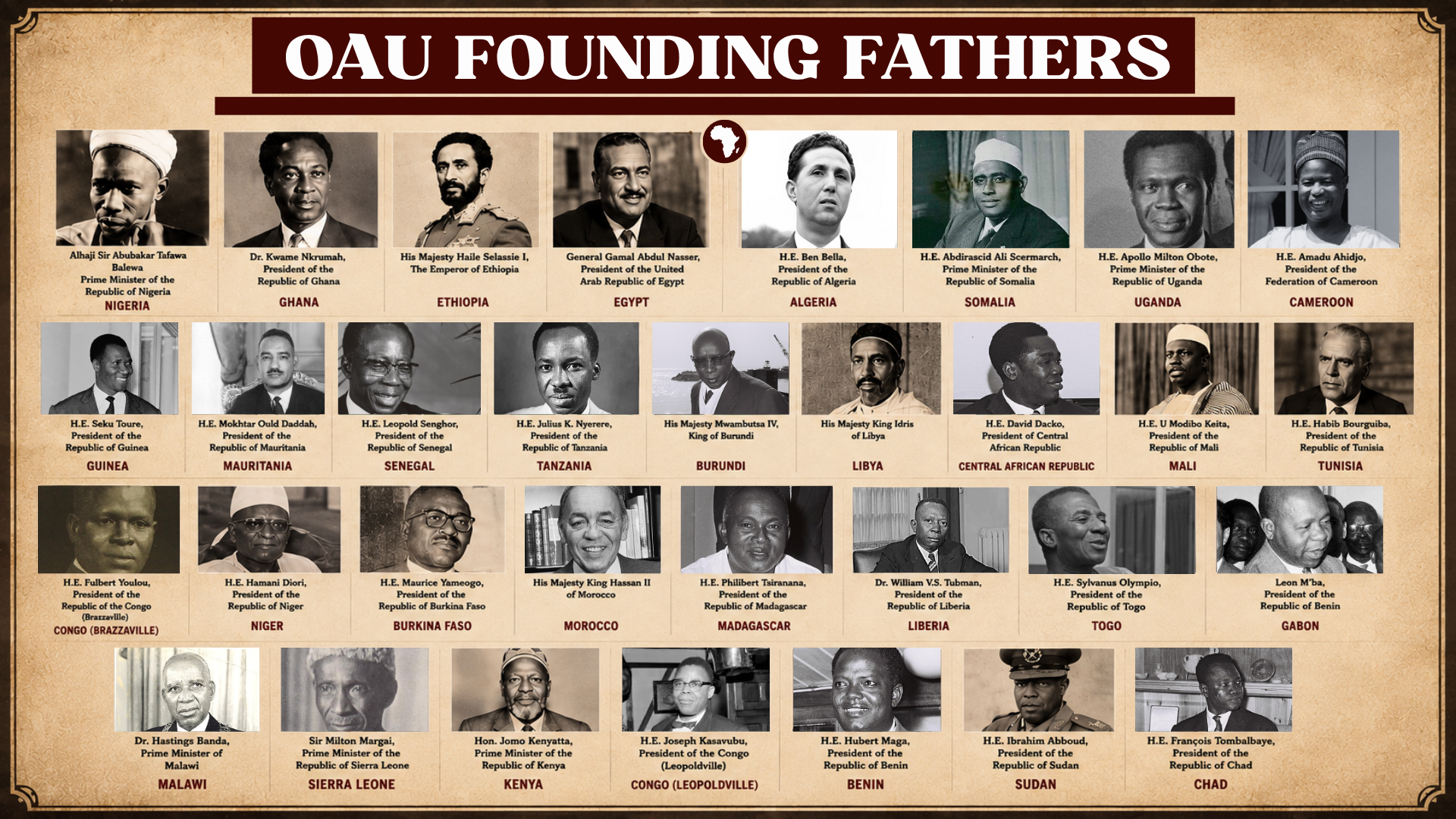
The Organization of African Unity (OAU) was established in 1963 and the establishment of the African Union (AU) was in 2002. The OAU's primary mandate centered on political liberation and anti-colonialism, while the AU era placed greater emphasis on economic integration and global partnership.
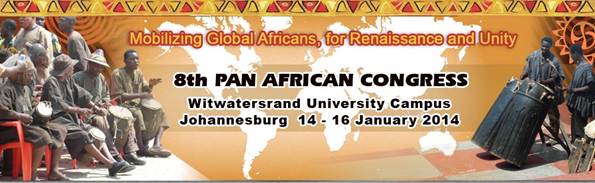
The eighth Pan-African Congress was held at the University of the Witwatersrand from January 14 to January 16, 2014, in Johannesburg, South Africa.
The Johannesburg Congress put forward several notable resolutions. It called for the creation of a Council for African National Affairs to organize and promote the rights of African migrant workers and foster Pan-Africanism. The Congress called for global recognition of an African right to return, solidarity with the whole of the African diaspora, and establishment of a National Reparations Commission in all countries where people of African descent exist.
The eighth Congress saw a political split among Pan-Africanists, with the Johannesburg Congress excluding North African Arab countries due to centuries of the Arab slave trade and the claim that in Arab countries where Africans were a minority, they faced racist discrimination and Arabisation.
This brought the organizers into conflict with those aligned with organizers of the seventh Congress, who viewed exclusion of North Africa as a violation of the basic principles of Pan-Africanism and the conclusions of the sixth and seventh Congresses.
The Johannesburg Congress defended its decision as emphasizing “Africanism” over “Continentalism,” viewing Arabs on the African continent as apart from the African identity and Pan-Arabism as contradictory to Pan-Africanism. The Johannesburg Congress was also criticized for being organized by a small elite group rather than being a grassroots effort. These criticisms led some Pan-Africanist organizations to consider the Johannesburg congress “nullified.”
A rival eighth Congress was organized and hosted in Accra, Ghana, from March 5 to March 7, 2015. Its theme was “The Pan-African World We Want: Building a people’s movement for just, accountable and inclusive structural transformation.
Major discussions included combating neoliberalism, sustainability and self-sufficient development, emancipation of African women, anti-imperialism, the role of art and media in promoting Pan-Africanism, holding African leaders accountable to Pan-African principles, and the role of youth in the Pan-Africanist Movement.
It condemned the NATO-led invasion of Libya and subsequent execution of Muammar Gaddafi, a sponsor of past Congresses, calling for the formation of an African Union brigade to act as an independent stabilizing military force for areas “previously destabilized by Western interests.”
It condemned neoliberalism and reiterated a call for greater economic cooperation between African states and creation of a unified African currency. It called for removal of all U.S. military bases from African soil. It resolved to concretize and unify the “6th Region of Africa”: the African Diaspora.

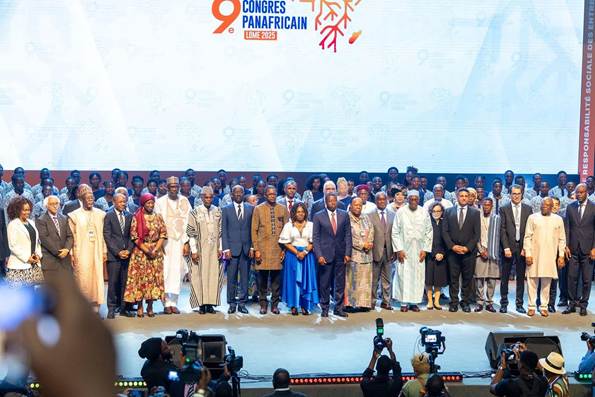
The ninth Pan-African Congress was held in Lomé, Togo, from December 8 to December 12, 2025, at the Palais des congrès de Lomé. North African states and all nations hosting communities of African descent were once again included in the event.
The theme of the ninth congress was “The renewal of Pan-Africanism and Africa's role in the reform of multilateral institutions: mobilising resources and reinventing ourselves to take action.”
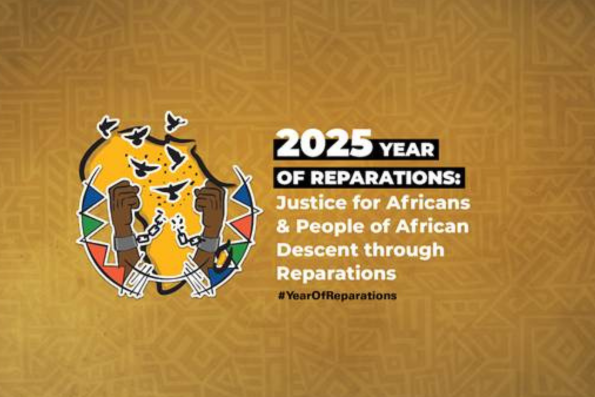
Six major decisions were made by the end of the Congress. The government of the Togolese Republic was entrusted with following up on implementation of commitments and decisions made at the Congress in collaboration with the African Union Commission, states in Africa and of the African diaspora, and various diaspora institutions. Additionally, a committee will be established to monitor implementation of decisions of the Congress.
The Congress called for establishment of a Pan-African Day of Remembrance for deportees and victims of slavery and colonization. It invited collaboration of the African Union, CARICOM, CELAC and diaspora organizations in selecting an appropriate annual date.
The Congress called on the Togolese Republic to draft a resolution to the United Nations General Assembly on establishing an International Day of Reparations and Restitutions.
The Congress called for establishment of a permanent office for the Pan-African Congress, which from 2025 onwards will organize a Pan-African Congress every five years in collaboration with a selected host country.
The Congress submitted its final declaration to the Assembly of Heads of State and Government of the African Union for consideration and implementation.
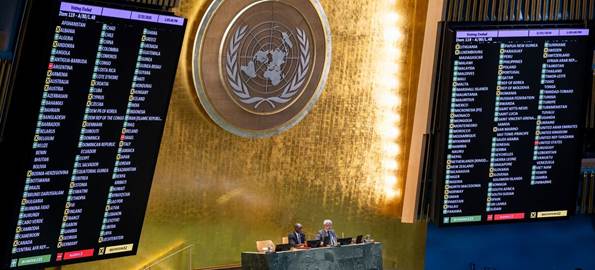
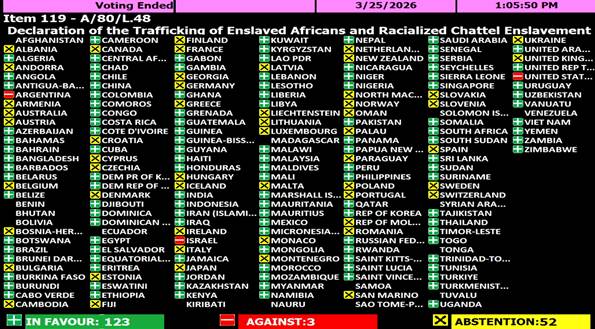
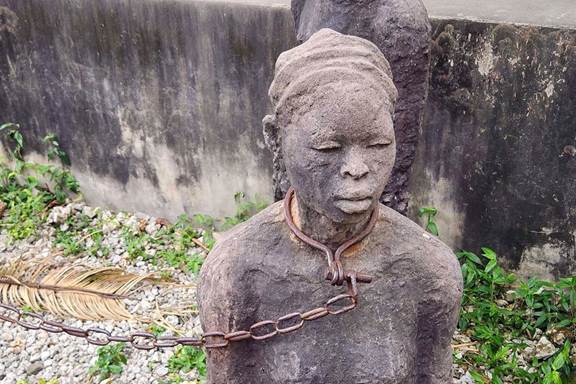
For more than 400 years, millions of people were stolen from Africa, put in shackles and shipped to the New World to toil in cotton fields and sugar and coffee plantations under scorching heat and the crack of the whip.
Denied their basic humanity and even their own names, they were forced to endure generations of exploitation with repercussions that reverberate today, including persistent anti-Black racism and discrimination.
The resolution emphasized “the trafficking of enslaved Africans and racialised chattel enslavement of Africans as the gravest crime against humanity by reason of the definitive break in world history, scale, duration, systemic nature, brutality and enduring consequences that continue to structure the lives of all people through racialized regimes of labour, property and capital.”
Source included in the original document: UN News, March 2026.

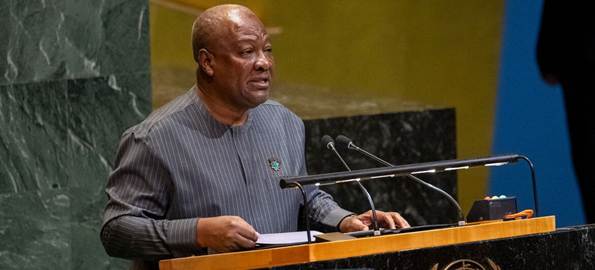
The Poet Laureate of Barbados, Esther Philips, read from some of her works, including a piece about a young girl walking on the grounds of a former sugar plantation and not understanding its historical significance as her ancestors buried there look on.
“There are spirits of the victims of slavery present in this room at this moment, and they are listening for one word only: justice.”
— Esther Philips, First Poet Laureate of Barbados
“Because for them and for the world, there can be no peace without justice - reparatory justice - and that call is answered only when words are turned into action. The question is, what will you do?”
— Esther Philips
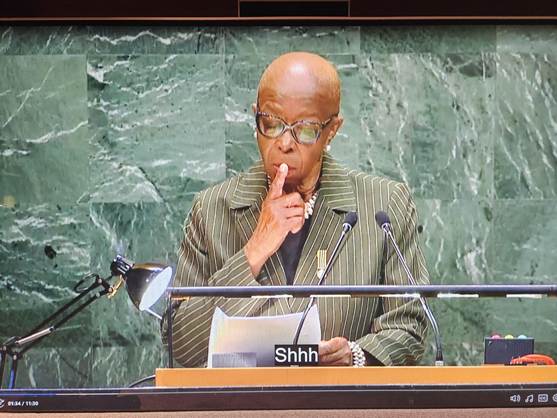
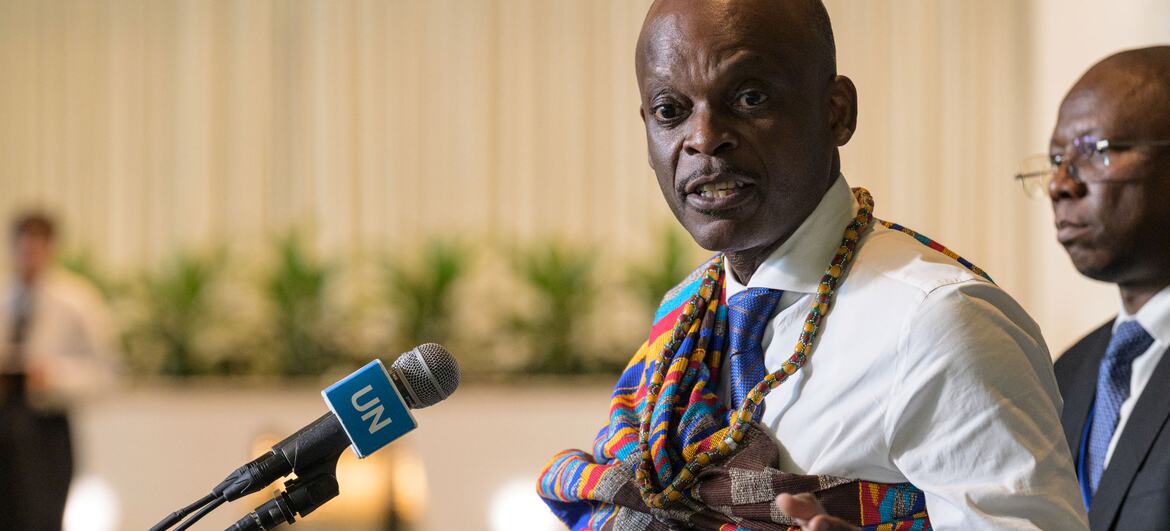
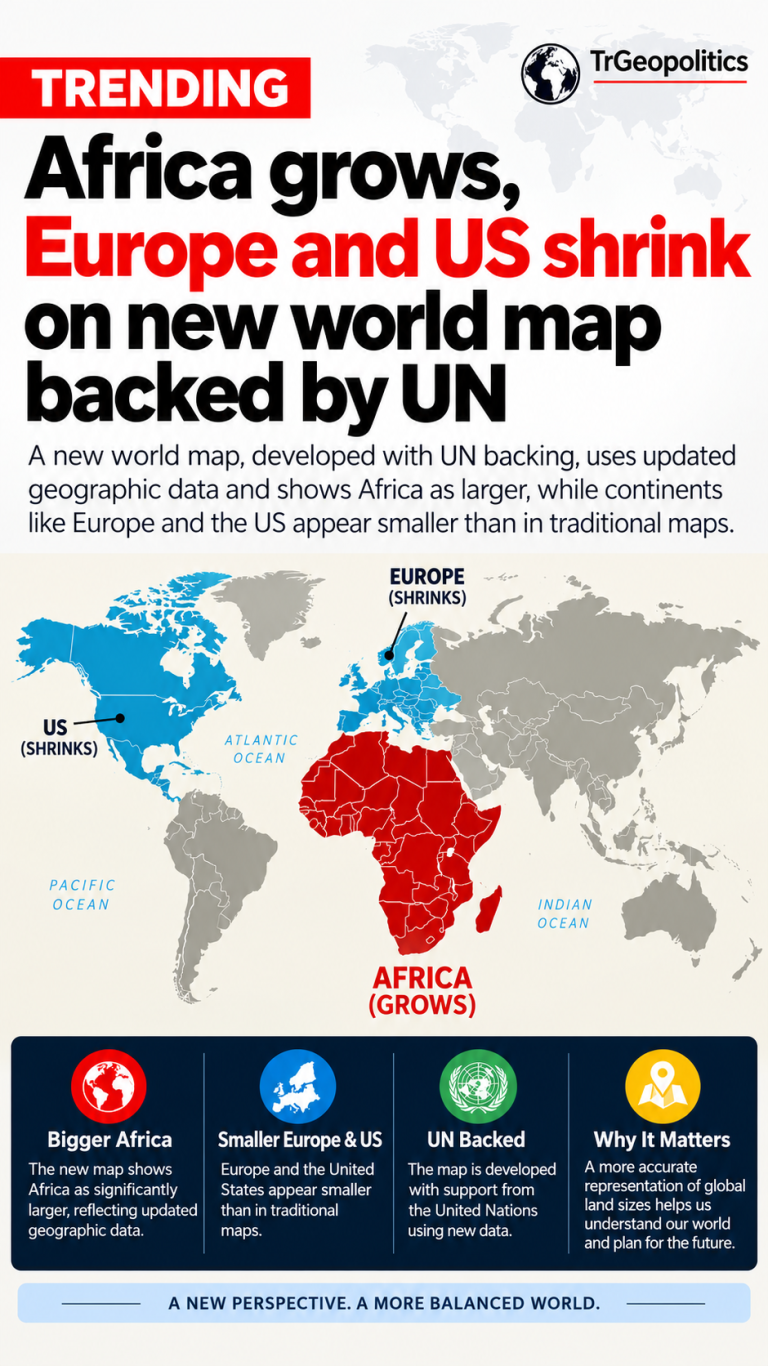
“Ahead of Friday’s vote, Togolese Foreign Minister Robert Dussey told news agency Reuters: “A fair world begins with a fair map.”‘ – Dussey
“He told a UN briefing earlier: “A map is never neutral. It shapes perceptions, influences how the place of peoples and continents in the world is understood.”‘ – Dussey
“Maps shape our understanding of the world,” Robert Dussey, Togo’s foreign minister, said before the vote. “They guide education, nourish the imagination, and influence collective perceptions.” – Dussey
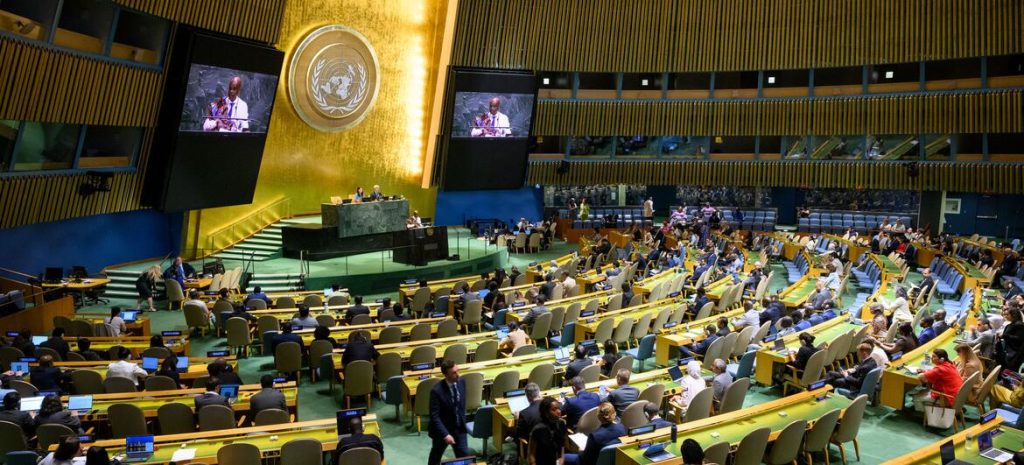
By 164 votes to one, Member States on Friday endorsed a resolution promoting map projections that more accurately reflect the true size of continents – the culmination of an African-led campaign against the 16th-century Mercator projection, still the most widely used map in the world.
The United States cast the sole vote against, dismissing the initiative as part of a “radical ideological project.”
Six countries – Estonia, Georgia, Lithuania, Moldova, Serbia and Ukraine – abstained.
Fastest Growing Economies in Africa (2025-2026 projections), as presented in the source document.
Through faith, collaboration, service, education, and advocacy, we are committed to empowering leaders and transforming lives.
We look forward to welcoming you back soon.
Pan African Religious Leaders Assembly
One Faith. One Africa. One Future.